ACM Transactions on Graphics · SIGGRAPH Asia 2021

Efficient and Robust Discrete Conformal Equivalence with Boundary

Marcel Campen  ·  Ryan Capouellez  ·  Hanxiao Shen  ·  Leyi Zhu  ·  Daniele Panozzo  ·  Denis Zorin
Osnabrück University  |  Courant Institute, New York University
DOI: 10.1145/3478513.3480557  ·  Vol. 40, No. 6  ·  December 2021
Use / , scroll wheel, or Space to navigate   ·   F for fullscreen

Outline

02 / 16

This talk walks through the problem, the mathematical machinery, our algorithmic contributions, and the empirical results.

01
Motivation & problem statement
02
Discrete conformal equivalence
03
Why fixed triangulations fail
04
Two flip strategies: degeneration vs. Delaunay
05
The hyperbolic Ptolemy trick
06
Newton algorithm with line search
07
Boundary handling: symmetric double cover
08
Symmetric flip catalogue
09
Results on real meshes
10
Numerical limits & comparison

Motivation & Problem

03 / 16

Given a manifold triangle mesh $M=(V,E,F)$ with edge lengths $\ell:E\to\mathbb{R}^{>0}$ and a target curvature $\hat\kappa_i$ per vertex, find new edge lengths that realise these curvatures while remaining conformally equivalent to the input.

Discrete curvature

Let $\Theta_i = \sum_{T_{ijk}}\alpha^i_{jk}$ be the angle sum at $v_i$. Then

$$\kappa_i = \begin{cases}2\pi - \Theta_i & v_i\text{ interior (Gaussian)}\\ \pi - \Theta_i & v_i\text{ boundary (geodesic)}\end{cases}$$

Applications

  • Flattenings: prescribe $\hat\kappa_i = 0$ in the interior.
  • Cone metrics: prescribe non-zero $\hat\kappa$ at a few cone points.
  • Seamless quad maps: $\hat\kappa_i = k_i\,\pi/2$ with $k_i\in\mathbb{Z}$.
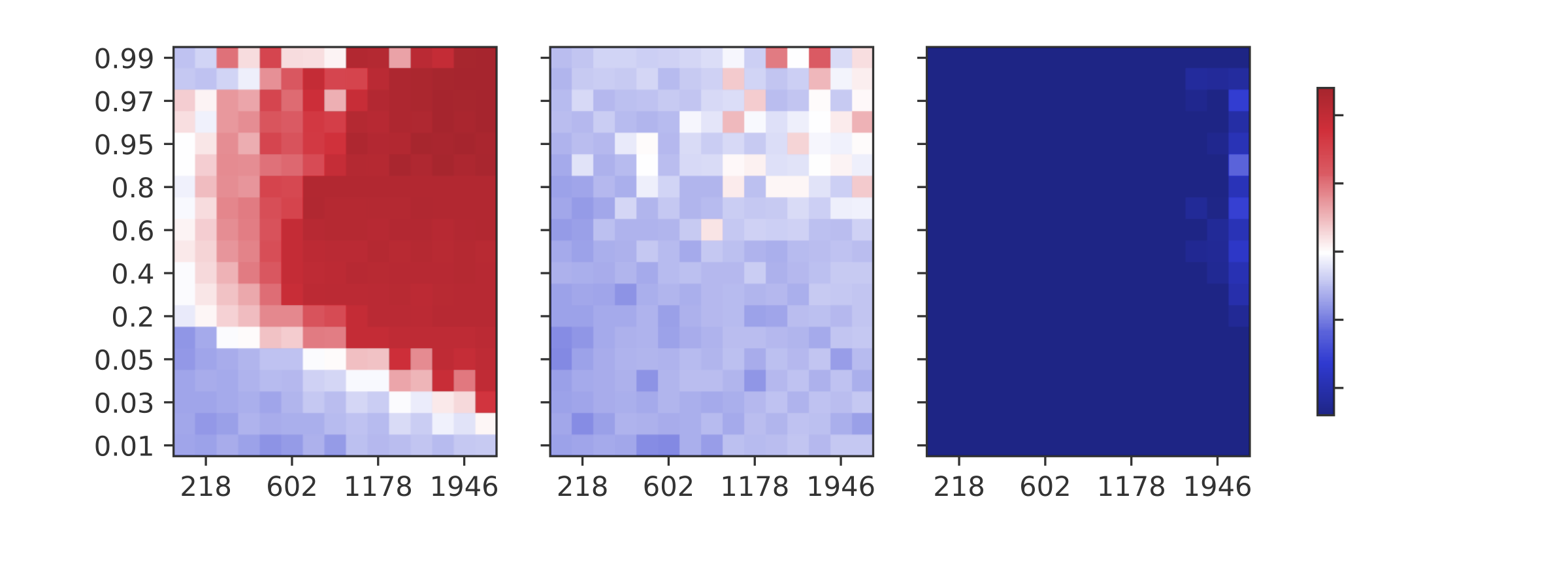
scale heatmap

Conformal scale factor on a complex model — easily spans many orders of magnitude.

Why is this hard?

  • Conformal scale factors can span hundreds of orders of magnitude.
  • Triangle inequality cuts the feasible region $\Omega$ into a tricky shape.
  • Surfaces with boundary need symmetry-aware machinery.
Discrete Conformal Equivalence

04 / 16

Per-vertex log-scale factors $\mathbf{u}:V\to\mathbb{R}$ reshape edge lengths multiplicatively (Luo, 2004):

$$\tilde\ell_{ij}(\mathbf{u}) \;=\; \ell_{ij}\;\exp\!\Big(\tfrac{u_i+u_j}{2}\Big)$$

For target angles $\hat\Theta$, a conformally equivalent metric satisfies, for every $i$:

$$g_i(\mathbf{u}) \;=\; \hat\Theta_i \;-\; \Theta_i(\mathbf{u}) \;=\; \hat\Theta_i \;-\; \sum_{T_{ijk}}\alpha^i_{jk}(\mathbf{u}) \;=\; 0$$

Key fact (Springborn 2008)

$\mathbf{g}(\mathbf{u})$ is the gradient of a twice-differentiable convex energy on the feasible set $\Omega_M\subset\mathbb{R}^n$.

So in principle a Newton method on $\mathbf{u}$ converges to the unique optimum.

The catch

The optimum may live outside $\Omega_M$ — the prescribed $\hat\Theta$ may be unreachable with the input triangulation.

For a vertex $v_i$ of valence $k$, no Euclidean metric admits

$$\kappa_i \;\le\; (2-k)\pi$$

since each interior angle is bounded by $\pi$.

Resolution. Allow the triangulation itself to change during optimisation.

Two Strategies for Dynamic Triangulation

05 / 16
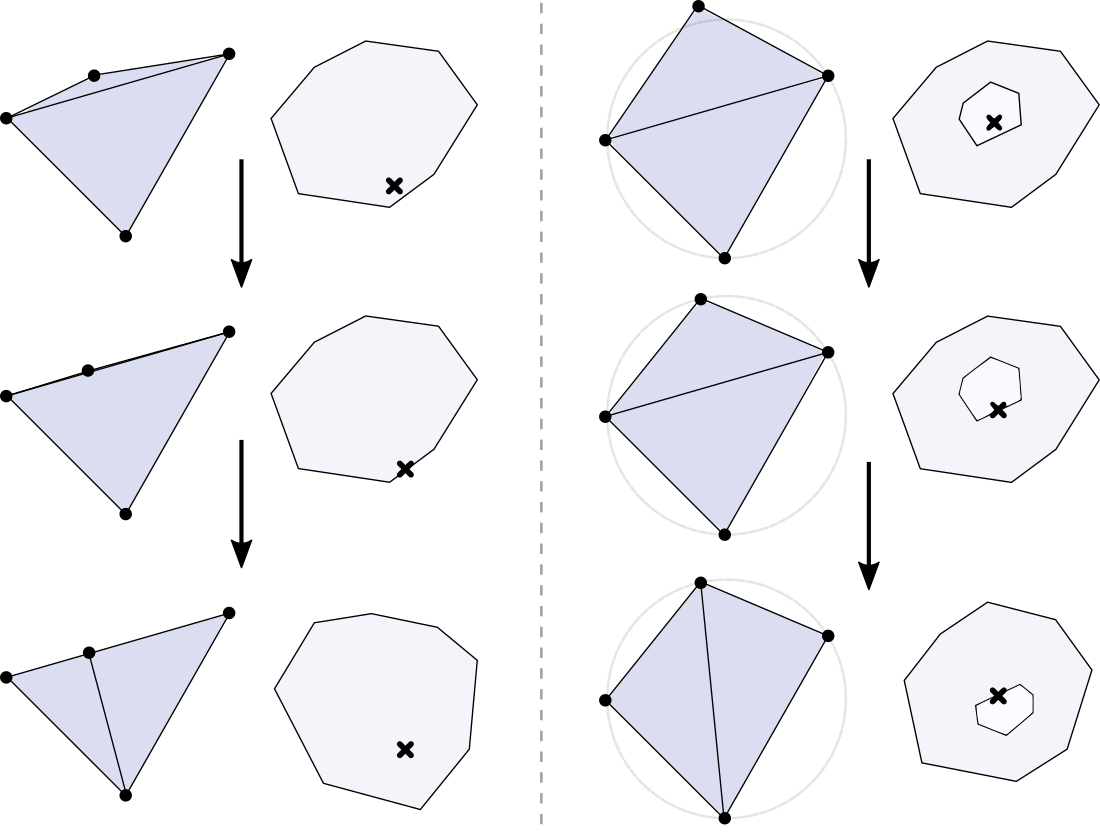
flips and feasible region

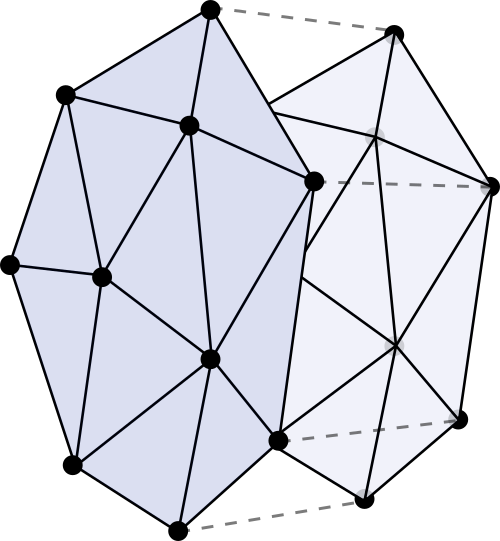
Left: flip-on-degeneration. Right: flip-on-Delaunay-violation. Light blue: feasible $\Omega$. White: Delaunay cell $\Delta$. The cross marks the current $\mathbf{u}$.

Degeneration flips

Luo 2004; Campen et al. 2017

  • Flip when a triangle degenerates (boundary of $\Omega$).
  • Stays in Euclidean feasible region.
  • Must locate every flip event along the path.
  • Open theoretical issues with simultaneous degeneracies.

Delaunay flips

Gu et al. 2018; Springborn 2019

  • Flip when four vertices become co-circular (boundary of $\Delta$).
  • Maintains an intrinsic Delaunay triangulation.
  • Energy becomes convex on all of $\mathbb{R}^n$.
  • More flips, but each is local and cheap.

The Delaunay strategy unlocks an unconstrained Newton method — and crucially, a hyperbolic re-interpretation that lets flips be applied in any order.

The Hyperbolic Ptolemy Trick

06 / 16

Instead of marching $t$ from 0 to 1 and detecting each Delaunay-critical event, jump straight to $t=1$ and run a generic flip algorithm on the (possibly invalid) lengths.

Algebraic Delaunay test

An edge $e_{ij}$ shared by triangles $T_{ijk},T_{jim}$ is Delaunay iff

$$\frac{\tilde\ell_{jk}^2+\tilde\ell_{ki}^2-\tilde\ell_{ij}^2}{\tilde\ell_{jk}\,\tilde\ell_{ki}} \;+\; \frac{\tilde\ell_{jm}^2+\tilde\ell_{mi}^2-\tilde\ell_{ij}^2}{\tilde\ell_{jm}\,\tilde\ell_{mi}} \;\ge\; 0$$

Ptolemy length update

When a flip swaps $e_{ij}\to e_{km}$ in an inscribed quadrilateral:

$$\boxed{\;\ell_{km} \;=\; \frac{\ell_{jk}\,\ell_{im} \;+\; \ell_{ki}\,\ell_{mj}}{\ell_{ij}}\;}$$

Applied in the original metric — scale factors $u_i$ cancel.
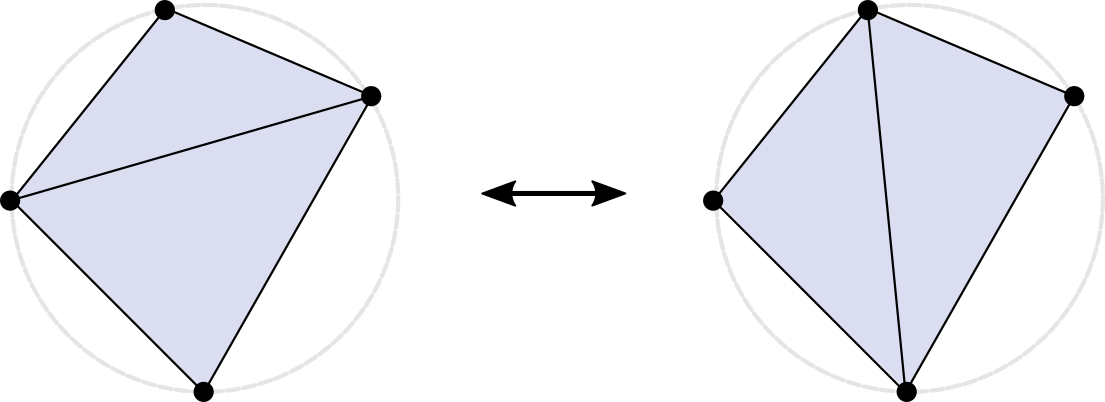
Ptolemy flip

A Delaunay-critical edge $e_{ij}$ in an inscribed quadrilateral, replaced by $e_{km}$.

Proposition (Weeks; Gu et al.)

Starting from any conformally scaled lengths $\tilde\ell$ — even if they violate the triangle inequality — the flip algorithm using the algebraic test and Ptolemy update terminates with an intrinsic Delaunay triangulation, conformally equivalent to the input. Flips may be applied in any order.
Newton Algorithm

07 / 16
function FindConformalMetric(M, ℓ, Θ̂): u ← 0 (M, ℓ) ← MakeDelaunay(M, ℓ, u) while not converged(M, ℓ, u): g ← Θ̂ − Θ(M, ℓ̃) # gradient H ← Hessian(M, ℓ̃) # Hessian d ← solve(H d = −g) # Newton dir. (M, ℓ, u) ← LineSearch(M, ℓ, u, d) ℓ̃ ← ScaleConformally(M, ℓ, u) return (M, ℓ̃)

Each iteration solves one sparse SPD system. Re-flipping happens lazily inside the line search.

Line search innovations

  • Trial Delaunay re-flip after every step using Ptolemy, so the Newton direction can step freely beyond $\Omega$.
  • Armijo-like acceptance test combining gradients at the full and half step:
    $$\tfrac12\!\left(\mathbf{d}^{\!\top}\!g_{1} + \mathbf{d}^{\!\top}\!g_{1/2}\right) \;\le\; \alpha\,\mathbf{d}^{\!\top}\!g_0$$
  • Backtracking until the projected gradient $\mathbf{d}^{\!\top}\!g(\mathbf{u}+\mathbf{d}) \le 0$.

Empirical convergence

  • $\le 10^{-10}$ angle accuracy in < 15 Newton iterations on the standard MPZ dataset.
  • 0.4 s average wall time on a 1K-vertex sphere with random target curvatures.

Surfaces with Boundary — Symmetric Double Cover

08 / 16
double cover

Glue two reflected copies of the boundaried mesh along their boundary loops. The result is closed but carries a reflection symmetry $R$.

Reduce the boundary case to the closed case (Sun et al. 2015 idea), then run the closed-case Newton algorithm — but the symmetry $R$ must be preserved at every step.

What goes wrong with naïve flipping

  • The reflection creates stable Delaunay-critical configurations: many quadruples become co-circular simultaneously.
  • Some flips would break $R$; others must happen in coordinated mirror pairs.

Our combinatorial machinery

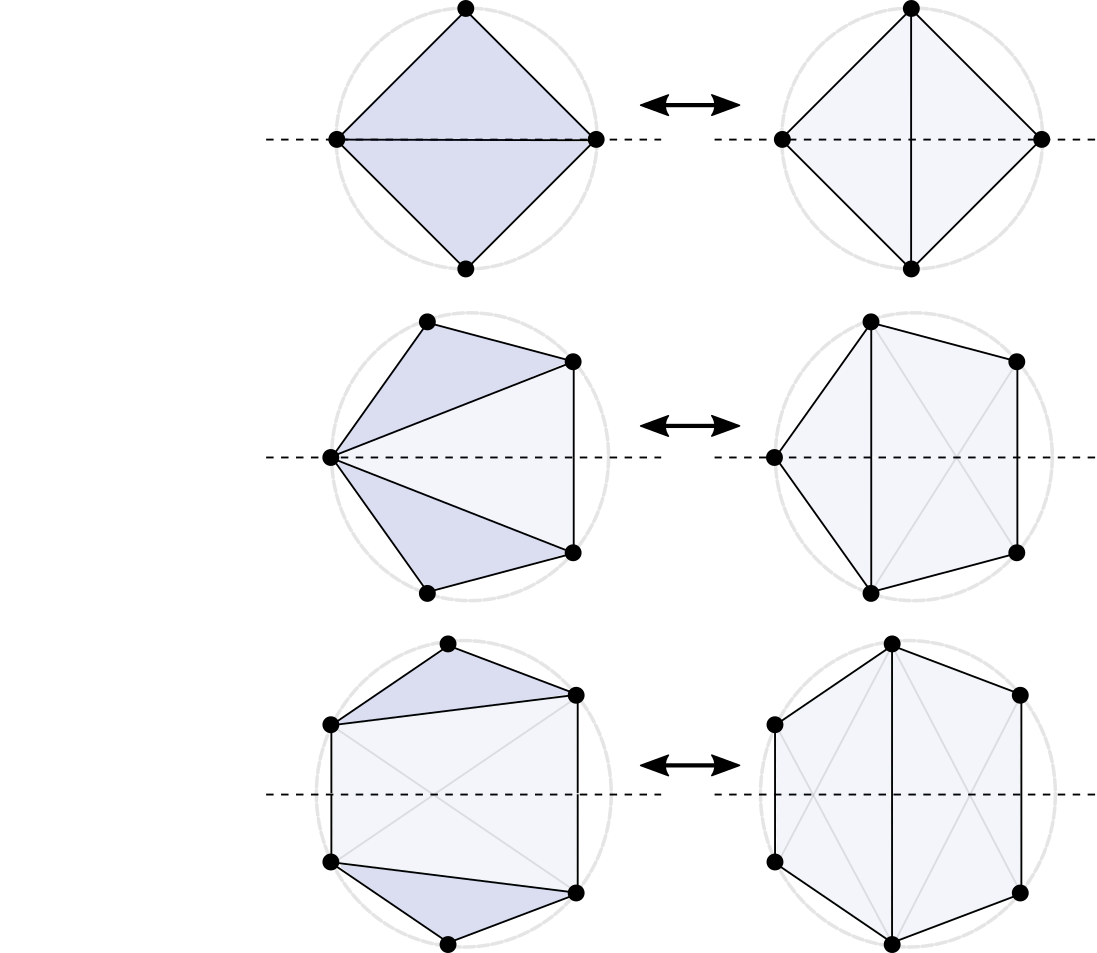
  • Classify every edge / face by symmetry class: , , ; same for edges.
  • Every flip is labelled by a triple $(\text{face}_a,\text{edge},\text{face}_b)$ — only a small number of combinations actually occur.
  • Prove that several of these combinations are Delaunay regardless of metric and can be skipped (Prop. on label compatibility).
  • For the rest, give explicit halfedge-cycle and reflection-map updates.

Symmetric Flip Catalogue

09 / 16

Symmetric pair flips

sym flips

Two mirror-image flips executed jointly to preserve the reflection $R$.

Self-symmetric (on-axis) flips
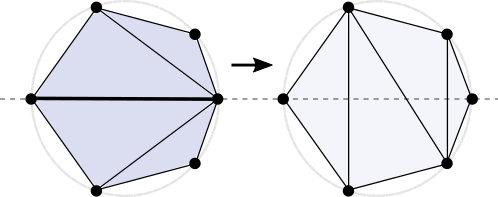
asym flips

A single flip that is its own mirror image — happens at edges lying on the symmetry line.

Why this matters. Without the catalogue, naïvely applying the closed-case flip algorithm on a symmetric mesh produces broken symmetry, runaway flips at the boundary, or incorrect Delaunay states. The classification gives a finite, provably-correct flip vocabulary.
Results — Closed Surfaces

10 / 16
closed results

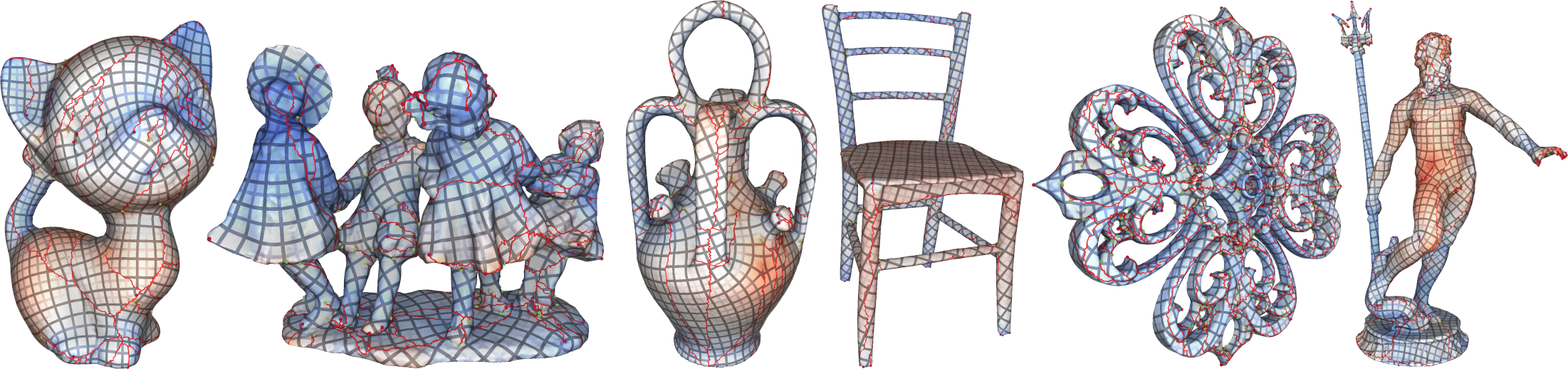
Conformal maps on the Myles et al. 2014 dataset, visualised with an adaptive grid texture. Cone vertices in green/red. Numbers in the corner indicate the number of orders of magnitude spanned by the conformal scale.

Results — Surfaces with Boundary

11 / 16
boundary results

Geodesic curvature prescribed to zero along boundary loops — the texture grid lines therefore meet the boundary at a constant angle per loop.
Results — Cut-Aligned Maps

12 / 16
cut results

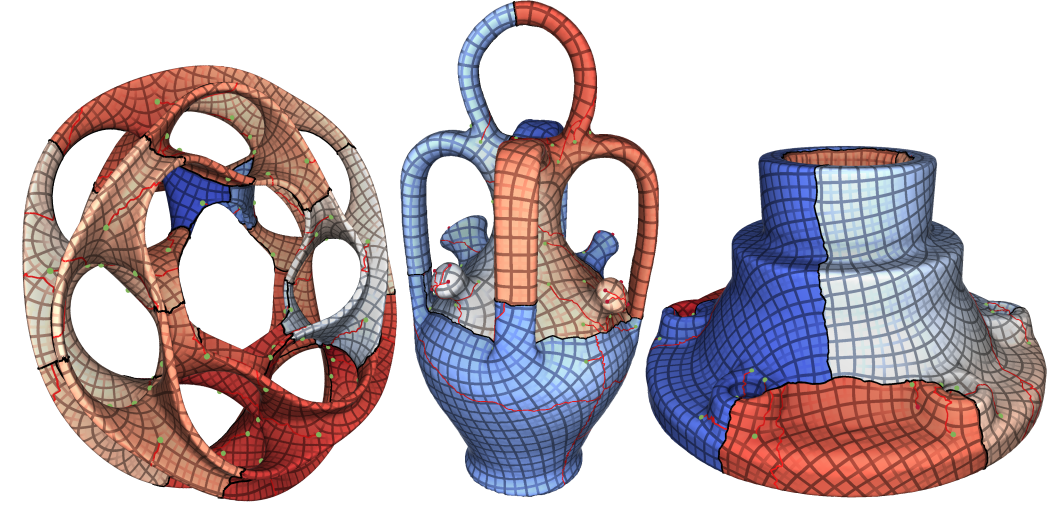
Closed models cut to disk topology along a cut graph (black). Geodesic curvature $\hat\kappa = \pi$ is prescribed along the cut so it becomes axis-aligned in the parametrisation. Numerically the most demanding scenario — one example spans 55 orders of magnitude in scale.
Pushing the Limits — Single-Cone Stress Test

13 / 16
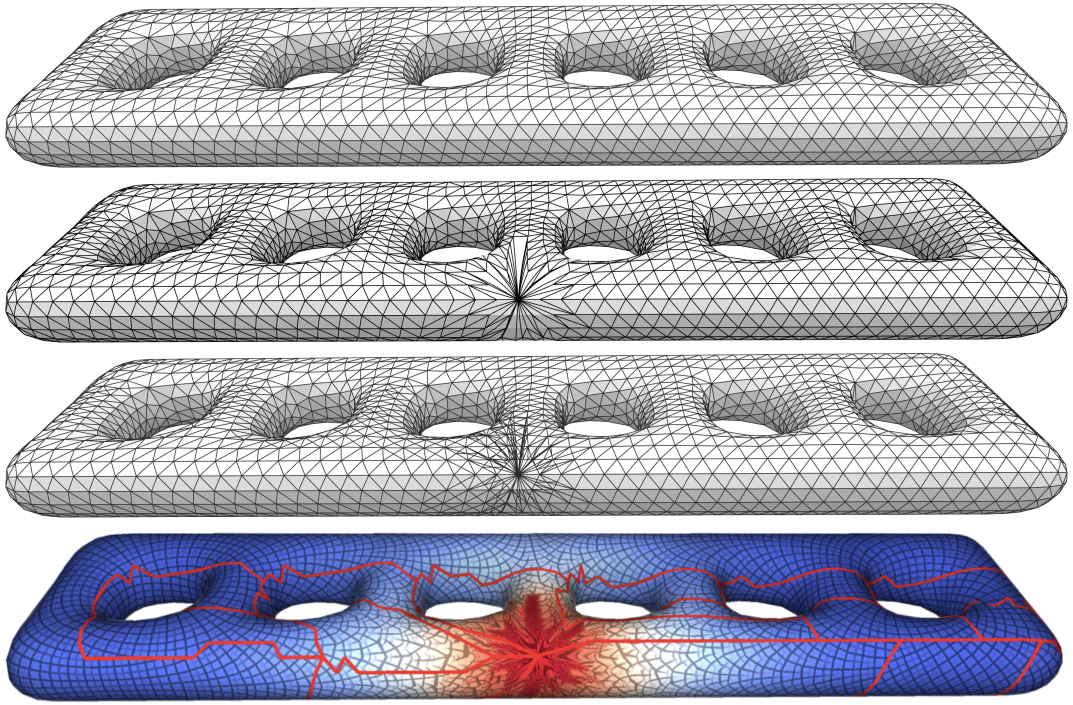
6-torus single cone

A genus-6 torus with all curvature concentrated at one vertex. Top to bottom: input mesh; resulting intrinsic retriangulation; overlay triangulation; hierarchical grid texture spanning 25 levels.

Concentrate all curvature at a single vertex of a $g$-torus (cone angle $2\pi(2g-1)$):

232
orders of magnitude in scale at $g=12$ (still benign in double precision)
$10^{-29}$
residual at $g=150$ with 200-bit arithmetic
611
orders of magnitude at $g=400$
$10^{-65}$
residual at $g=400$ with 400-bit arithmetic

By varying arithmetic precision we can exchange compute for accuracy on truly extreme inputs — there is no fundamental algorithmic barrier.

Comparison vs. Degeneration-Flip Method

14 / 16
73×
average speed-up over the degeneration-flip method on 1000 random cases (10K-vertex sphere)
0.4 s
average wall time to $\varepsilon = 10^{-10}$
vs. 29.6 s for degeneration flips
$10^{-10}$
angle accuracy reached in < 15 Newton iterations on the standard dataset

Why faster?

More flips (cheap, local) but far fewer linear system solves (expensive, global). The Newton step is unconstrained, so the line search no longer fights with feasibility boundaries.

Why more robust?

The hyperbolic interpretation lets intermediate states violate the triangle inequality safely. Extreme small/large prescribed angles converge in cases where the degeneration-flip method stalls or diverges.

Contributions

15 / 16

Thank you

Code, data, and additional results accompany the ACM TOG publication.

Marcel Campen, Ryan Capouellez, Hanxiao Shen, Leyi Zhu, Daniele Panozzo, Denis Zorin
ACM Transactions on Graphics (SIGGRAPH Asia), Vol. 40, No. 6, December 2021
DOI 10.1145/3478513.3480557
scroll · ↑↓ · space